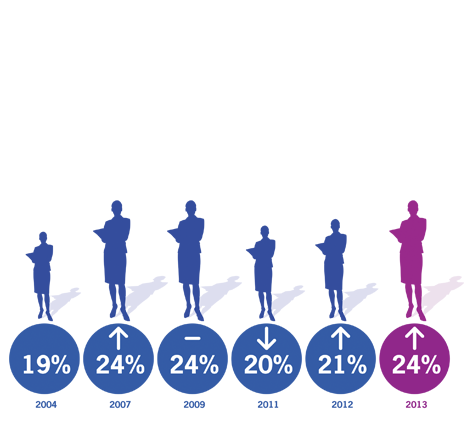
Our latest Women in Business report reveals the pace towards parity in mid-market firms isn’t moving fast enough. A young woman starting her career today will be working for more than a quarter of a century before she can expect to work at a mid-market firm with gender parity in top senior roles. Our research explores how gender balanced teams can bring better business performance – and with small and mid-market firms making up the largest part of the global economy [i], now is the time to keep up the pressure.

In the next edition of Grant Thornton’s series on trending international insights, we examine how a shifting economic landscape can offer the mid-market an opportunity to grow while their larger counterparts opt to ‘wait and see.’
In the next edition of Grant Thornton’s series on trending international insights, we examine how disruption can be an opportunity for growth and differentiate mid-market firms from competitors.
Developers, property companies, investors and homeowners suffered disproportionately during the financial crisis. But now, finally, expectations for profitability, jobs and orders are all on the rise.
Drawing on interviews with banks, private equity houses, advisers and hoteliers, the report calls for hotel businesses to address the way they deal with lenders and investors if they are to raise money in the new environment.
Business leaders remain cautious about their current and future commitment to M&A. However, this year’s results reveal an increased appetite for cross-border acquisitions, which is at its highest level since the IBR first asked this question in 2008.
This publication summarises the overall objectives and requirements of IAS 36, provides a step-by-step guide to performing an impairment assessment (including recording or reversing an impairment when necessary) and offers insights on best practices to address interpretative and practical application issues.
This publication guides management through the top 20 disclosure and accounting issues identified by Grant Thornton as potential challenges for IFRS preparers.
Wherever I go in the world, I’d rather be walking a dog than stroking a cat. Some things are the same wherever you are. But does this include business leaders? Working with senior business people across the globe, I’ve found they do share a lot of traits – valuing integrity, a positive attitude and the ability to communicate – even across wide cultural divides.
The role of leaders in creating successful businesses and driving growth is crucial. How these leaders run their teams and make decisions can be the difference between success and failure. But do the leadership characteristics displayed by leaders vary from region to region?
I read a fascinating article in the Wall Street Journal the other day which suggested that my region could broadly be thought of as two separate entities.
The next 12 months hold a number of opportunities and challenges for Latin America. An estimated 600,000 visitors will descend on Brazil for the FIFA World Cup. They will be joined by television viewers across the globe as Brazil attempts to show the world that despite stadia construction delays and social unrest during the Confederations Cup last summer, it is open for business.
The technology industry is synonymous with innovation, fuelled by investments and a continual focus on research and development (R&D). By its very nature it is at the forefront of change. Those businesses which fail to keep up with technological change and stay current with consumer requirements are left behind.
More and more fiscal authorities continue to develop their transfer pricing laws. The principles are common, although interpretations differ from one tax authority to another.
As more and more goods and services are crossing national borders than ever before, and with indirect taxes being adopted by a growing number of tax authorities, international businesses are facing tax issues in many overseas countries - including the possibility of having to account for tax in the country where their customer is located.
Drawing on data and insight from the Grant Thornton International Business Report (IBR), the Economist Intelligence Unit (EIU) and the International Monetary Fund (IMF), The global economy in 2014 answers these questions and more.
We asked the 3,500 business leaders who responded to our latest Grant Thornton International Business Report (IBR) a new question in Q4-2013: Do you expect rising energy costs to constrain the growth of business over the next 12 months?
The lure of China’s less well-known cities and the opportunities they present has been picking up speed for years, along with their impressive growth. In fact, while they are often described as ‘second-tier’ cities, many are in fact now wealthier than their ‘first-tier’ counterparts.
The economy of France continues to suffer as the eurozone crisis continues. Following a deep contraction in 2009, the economy recovered robustly, posting seven consecutive quarters of expansion. However, France has stagnated over the past two years as problems in southern Europe intensified, with growth slowing as unemployment and government debt rise.